
Pricing
Priced per hull,
not per person
A boat is the thing being managed, so a boat is the thing being billed. Invite the crew, the yard, the surveyor and the accountant — the price does not move.
Photo: User_Pascal
Owner
One boat
An owner or captain who wants their own vessel under control.
- Unlimited tasks, history, spares and passages
- Scheduling by date, engine hours or miles
- Spend, suppliers and receipt scanning
- Export for your accountant
- iOS and Android app, offline
- Incidents reported from the phone, in seconds
- Alerts for due work, engine hours, miles, low stock and certificates
- Inventory with barcode scanning
- Calendar subscription and the Nauticore Agent
- The maintenance passport for when she sells
Fleet
Many boats
Charter operators and management companies, billed per hull with volume steps.
- Everything in Owner, on every vessel
- Fleet dashboard with weighted compliance
- Roles per vessel and per project
- Contractors scoped to one refit
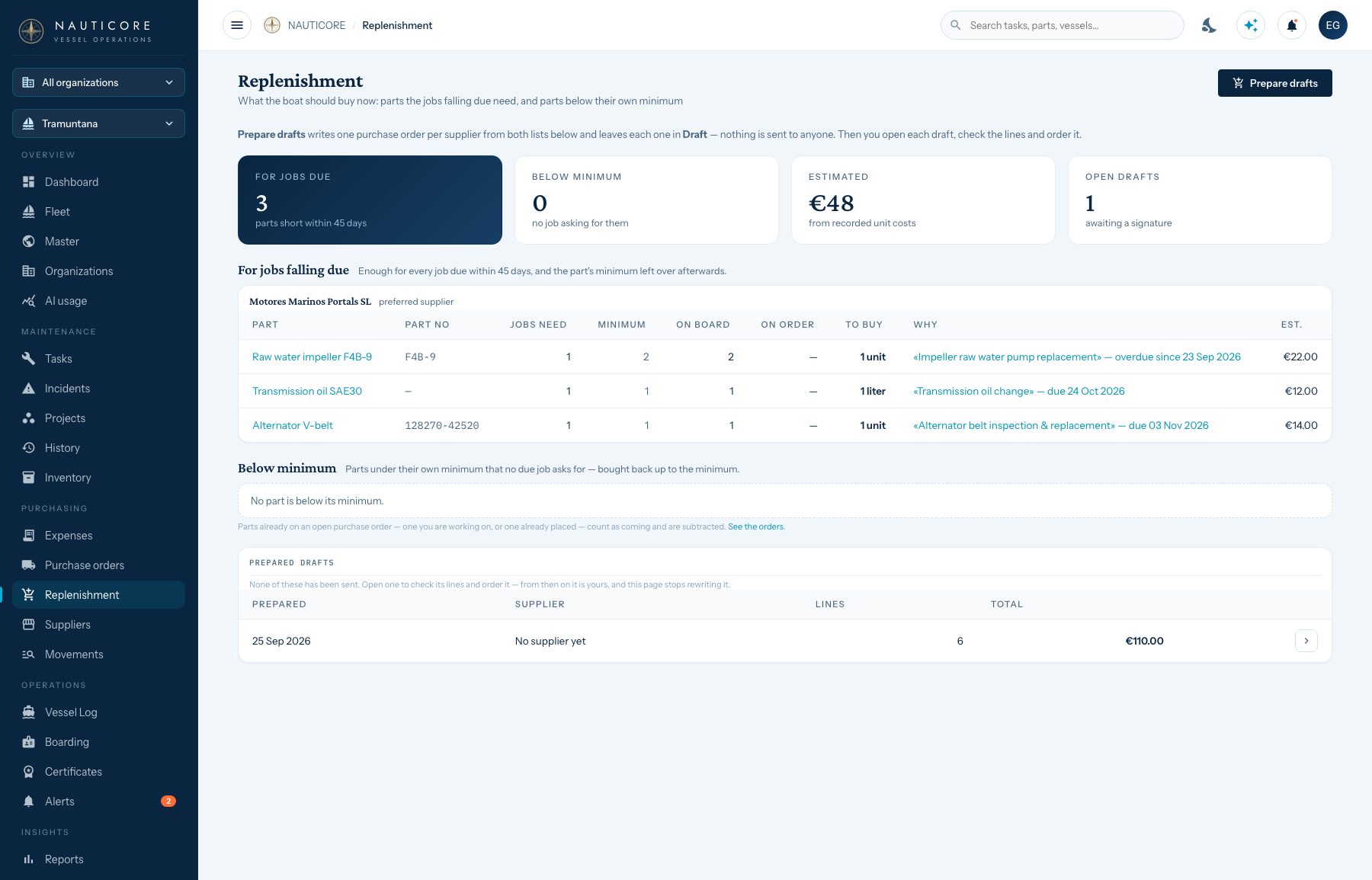
- Replenishment: draft orders per supplier from what the jobs need
- Preventive work orders drafted from what’s coming due
- Purchase orders sent to suppliers, received line by line
- Supplier statements and the movements ledger
- Onboarding, including your existing service history
Enterprise
Your own instance
Clients who need a dedicated deployment, data sovereignty and an agreement in writing.
- A private, dedicated instance
- Your choice of region
- Support agreement and named contact
- Priority onboarding and data migration
- Single sign-on, on request
What comes with the plan
Working while
you’re ashore
Every hour NAUTICORE re-reads each boat and prepares the paperwork. Nothing is sent, approved or deleted without a person — and none of it is an add-on.
Replenishment:
the orders write themselves
The jobs due in the next 45 days, the parts they consume, what is on board and on order — plus anything below its minimum. Prepare drafts turns it into one purchase order per preferred supplier.
- Every line says which job needs it, and when
- Drafts only — you check the lines and place the order
- Sent to the supplier by email with a signed, expiring link
Nauticore Agent
Ask about the boat in plain words — on the web or the phone. Answers from that person’s own data, and it can draft a work order for review.
Alerts & low stock
Overdue and due-soon work, engine hours, miles, expiring certificates and parts below minimum — raised every hour.
Incidents
Report a fault from the phone in seconds. Turn it into a task or a work order, close it, or discard it with a reason.
Calendar & notices
The schedule in Google or Apple Calendar; a daily email brief, in-app notices and Telegram — each person mutes what they don’t need.
Inventory
Each task knows the parts it consumes and moves the stock when it is done. Scan a barcode to find a part.
Replenishment
Draft purchase orders per supplier, built from the jobs falling due and the parts below their minimum.
Preventive work orders
A work order drafted from what is coming due by date, hours or miles — approved or declined by a manager.
Purchase orders
Sent to the supplier by email, locked once sent, and received line by line — even when half the order arrives.
Why there are no numbers on this page
Because we onboard
by hand
NAUTICORE runs real fleets today, and every one of them came aboard with a conversation rather than a checkout page. That is a deliberate limit on how fast we take clients on: onboarding usually means bringing a decade of paper history across, and that is not something to do at scale before it is done well. Ask, and you will get a straight figure for your fleet on the call.
What counts as a vessel?
One hull under management. A vessel laid up for the season still holds her history and her documents, so she still counts — but tell us, because long lay-ups are exactly the kind of thing a sensible price accounts for.
Is there a limit on users?
No. Per-seat pricing punishes you for inviting the yard, the surveyor or a relief skipper — which is precisely when a maintenance record earns its keep. Invite whoever needs access, scoped to what they should see.
Does the Nauticore Agent cost extra?
It is included. Every call it makes is metered inside the platform, so the running cost is a number we can both look at rather than an open tap.
Are the automations an add-on?
No. Alerts, schedules, incidents and the Nauticore Agent come with every plan; replenishment, preventive work orders and purchase orders come with Fleet. None of it is priced separately, and none of it acts without a person — it prepares, you decide.
What does onboarding involve?
Setting up your organisation and vessels, importing spares and suppliers, and — the part that takes real work — bringing the existing service history across from whatever it lives in today. That last piece is what makes the record worth something immediately instead of in a year, and it is quoted with the rest.
Can we leave?
Yes, and take the data. Spend and service history export in standard formats, and a vessel’s record can be shared with a buyer or surveyor through an expiring link without giving anyone an account. A maintenance record you cannot get out of the software is not a record, it is a hostage.

Come aboard
Get a figure
for your fleet
Tell us how many hulls and how they are run, and you will get a straight number.